
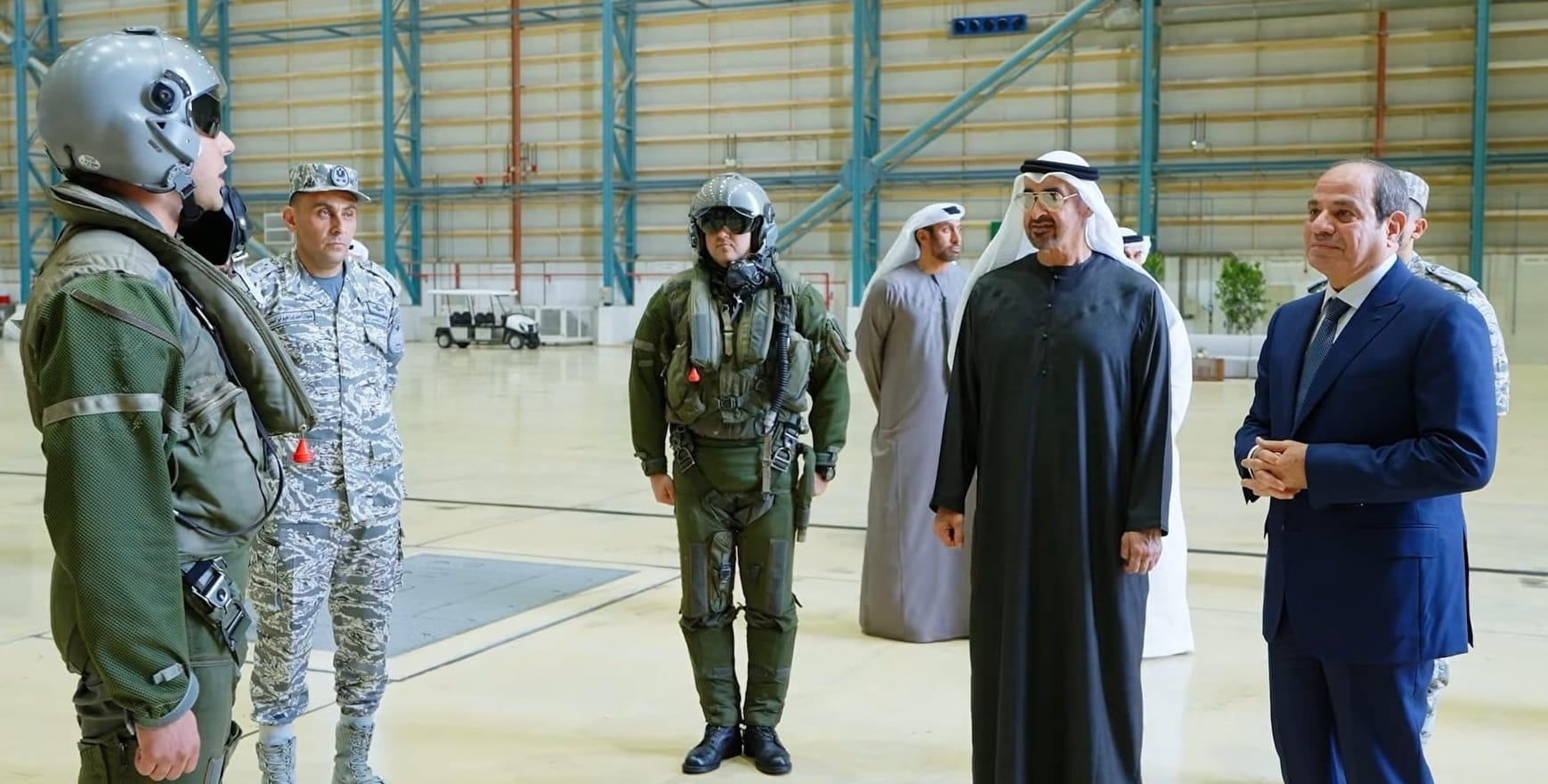
The joint visit by UAE President Sheikh Mohamed bin Zayed Al Nahyan and Egyptian President Abdel Fattah el-Sisi to an Egyptian fighter-jet detachment stationed in the UAE marks a notable escalation in the public visibility of Egyptian-Emirati military coordination.
The visit was not presented as a routine inspection. According to the Emirates News Agency, the two leaders reviewed the detachment’s readiness and efforts to strengthen operational capabilities “for various challenges,” after discussing regional developments and their implications for regional and international security.
This appears to be the first public announcement that an Egyptian fighter detachment is stationed in the UAE. This was the first time the presence of such a detachment had been announced, while official Emirati language described it as already “stationed” in the country. This suggests either a deployment that had not previously been publicized, or a recent operational move whose publicity is itself part of the message.
The available official statements do not specify the number of aircraft, their type, the rules of engagement, the base where they are stationed, or the duration of the deployment. But the images published by the ENA show Dassault Rafale fighters with the Egyptian flag print, 13 Egyptian pilots, and three persons in Egyptian military uniform.
Egypt became the Rafale’s first foreign customer in February 2015, when it signed a deal with France for 24 Dassault Rafale multirole fighter jets as part of a larger arms package that also included a FREMM frigate and missiles. The first aircraft were delivered only months later, in July 2015, reflecting Cairo’s urgency to modernize its air force and diversify away from dependence on U.S. platforms.
In May 2021, Egypt ordered 30 additional Rafales, bringing the planned Egyptian fleet to 54 aircraft and making Egypt one of the largest Rafale operators after France. Dassault said the second contract “completes” the first 2015 acquisition and would bring the Egyptian Air Force’s Rafale fleet to 54 aircraft.
The visit came during a sharp regional crisis after the UAE said it had faced Iranian missile and drone attacks. The UAE’s Defense Ministry said its air defenses were dealing with missile and drone attacks from Iran, while Iran’s joint military command denied carrying out such operations; Reuters said it could not independently verify either side’s account. The UAE also said the attacks represented a direct threat to its security and reserved its right to respond.
Cairo denounced the reported Iranian attacks on Emirati territory, said they caused a fire at a fuel facility in Fujairah and injuries, and reaffirmed support for measures taken by Abu Dhabi to protect its security and sovereignty. The Egyptian presidency said that President Sisi affirmed Egypt’s solidarity with the UAE, rejected Iranian attacks on Emirati sovereignty, and stated that “what affects the UAE affects Egypt.”
The timing also matters because the UAE itself has moved onto an emergency footing. The UAE restricted flights to a handful of approved routes until at least May 11 and activated emergency security protocols through NOTAMs issued by its General Civil Aviation Authority. UAE air defenses had been thwarting Iranian missiles and drones, forcing multiple flights to divert to Muscat and circle over Saudi Arabia.
A previous report by The Pundit noted that Saudi Arabia, the UAE, and Kuwait reportedly sought Egyptian and Moroccan support to reinforce their air-defense posture, with Morocco providing personnel and intelligence support and Egypt reportedly transferring advanced air-defense assets, including upgraded Skyguard Amoun systems, to Gulf partners.
The Egyptian deployment should be read against a longer history of UAE-Egypt military cooperation. The two countries have held repeated joint drills under the “Zayed” series. In 2021, the UAE and Egypt concluded the “Zayed 3” air exercise in the UAE, involving Emirati and Egyptian air forces, lectures and practical training, joint air missions, air-combat strategies, multi-role fighter flights, attacks on enemy targets, and defense of vital locations.
Egypt’s Ministry of Defense described the same “Zayed 3” air exercise as involving multi-role fighters from both sides conducting joint sorties, training on attacking hostile targets, defending vital objectives, and aerial refueling. It said the drills were designed to enhance joint air-combat operations and strengthen the ability of both forces to confront risks and challenges affecting regional security and stability.
Still, there is no public confirmation that Egyptian pilots engaged Iranian drones or missiles. There is no public confirmation that the detachment is part of a formal collective-defense arrangement. There is also no official disclosure of the aircraft type; images circulated by media may invite speculation, but the official Emirati and Egyptian statements do not identify the model.
In practical terms, the Egyptian fighter detachment may serve several purposes: joint patrol readiness, rapid-response coordination, protection of critical infrastructure, training under live crisis conditions, and political deterrence. But the most important function may be communicative.



Leave a Reply