Donald Trump on Tuesday issued one of the most extreme public threats ever made by a sitting American president against another nation’s people and infrastructure. In a Truth Social post, he warned that “a whole civilization” in Iran could die “tonight,” while framing the moment as the possible end of 47 years of Iranian political life through what he called “Complete and Total Regime Change.” Reuters and the Associated Press also reported that Trump had threatened to destroy Iran’s bridges and power plants if Tehran did not comply with his deadline over the Strait of Hormuz.
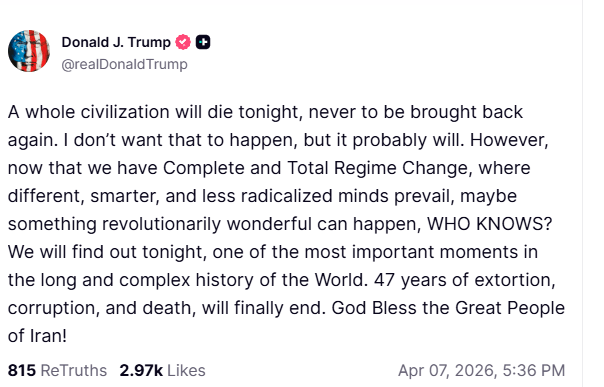
The language matters not merely because it is incendiary, but because it is directed at a country’s social existence as such. This was not the language of limited military compellence or narrow deterrence. It was the language of annihilatory spectacle: of collective punishment imagined as strategy, and of “civilization” itself cast as a legitimate object of destruction. That rhetoric came after earlier remarks in which Trump was reported to have described Iranian leaders as “animals,” a further sign of the dehumanizing register in which the crisis is now being publicly narrated.
Under the U.N. Charter, states must refrain from the threat or use of force against the territorial integrity or political independence of another state. In the law of armed conflict, parties must distinguish between military objectives and civilian objects; attacks may not be directed at civilian infrastructure as such, and even dual-use targets remain subject to proportionality and precaution rules. The ICRC’s customary-law database also states that “acts or threats of violence” whose primary purpose is to spread terror among civilians are prohibited, and that objects indispensable to civilian survival may not be attacked or rendered useless.
That is why Trump’s threats have triggered warnings from legal experts and international-law specialists. AP reported that experts viewed his threats against bridges and power plants as potentially amounting to war crimes if carried out unlawfully, because such systems are foundational to hospitals, water treatment, transport, and civilian life. Reuters, in a separate legal explainer, noted that attacks on civilian installations can amount to war crimes when they are not justified by military necessity or when the expected civilian harm is excessive. (AP News)
The seriousness of such threats lies not only in what they authorize militarily, but in what they normalize politically. To threaten the destruction of electrical grids, transport links, and other civilian infrastructure in a country of nearly ninety million people is to threaten cascading civilian harms: blackouts in hospitals, paralysis in water and sanitation systems, interruption of food distribution, internal displacement, and mass panic. Those effects are not collateral to modern infrastructure war; they are its predictable grammar. The legal question is therefore inseparable from the moral one: a state cannot plausibly threaten the ruin of civilian life and then claim innocence because the vocabulary used is “pressure” rather than “punishment.”
The threat also carries grave geopolitical consequences. Reuters reported that markets remained on edge as Trump’s deadline approached, while the Guardian’s business coverage said Brent crude rose above $110 a barrel amid fears of further escalation around Hormuz. AP likewise noted that the threats had already destabilized oil markets and intensified fears of a wider war. In other words, even before any final strike order, the rhetoric itself was already functioning as a weapon against global economic stability.
Yet there is another layer to the story, one the markets have learned to recognize even when diplomats do not: Trump’s repeated pattern of maximalist threats followed by reversals, delays, or partial retreats. Reuters has described the now-familiar “TACO” trade—“Trump Always Chickens Out”—as an investor shorthand for betting that Trump’s most extreme threats will eventually be softened once markets convulse or economic pain becomes politically costly. Reuters wrote in March that the Iran war could prove “one TACO too far,” while another Reuters commodities analysis later said crude markets were still pricing in the expectation that Trump would ultimately deliver yet another retreat.
That does not make this latest threat harmless. On the contrary, the TACO pattern may itself be part of the danger. A leader who repeatedly drives crises to the brink conditions markets, allies, adversaries, and domestic audiences to treat existential rhetoric as negotiable theater. That creates a lethal ambiguity: some threats may be bluffs, but none can safely be assumed to be bluffs. The result is a politics of continuous brinkmanship in which the line between coercive signaling and unlawful violence grows ever thinner. Reuters noted that Trump has been seen by investors as “prone to abrupt reversals,” even as he reiterates threats of massive retaliation and regime change.
In April 2025, Trump posted that it was a “great time to buy” shortly before announcing a major tariff pause that sent stocks soaring; Reuters later reported well-timed options activity ahead of that announcement, and lawmakers called for investigations into possible market manipulation or insider trading. Those allegations remain allegations, but they form part of the context in which any Trump-induced market swing must now be read.
So the central fact is this: the threat is serious whether or not it is carried out. If Trump follows through, the world confronts the possibility of unlawful attacks on civilian infrastructure and an even wider regional war. If he backs down, the episode still leaves behind a damaged legal order, a terrorized civilian population, and markets trained to speculate on presidential menace as a tradable asset. The degradation is not only military. It is institutional, juridical, and civilizational in its own right.


 THE PUNDIT
Leave a comment