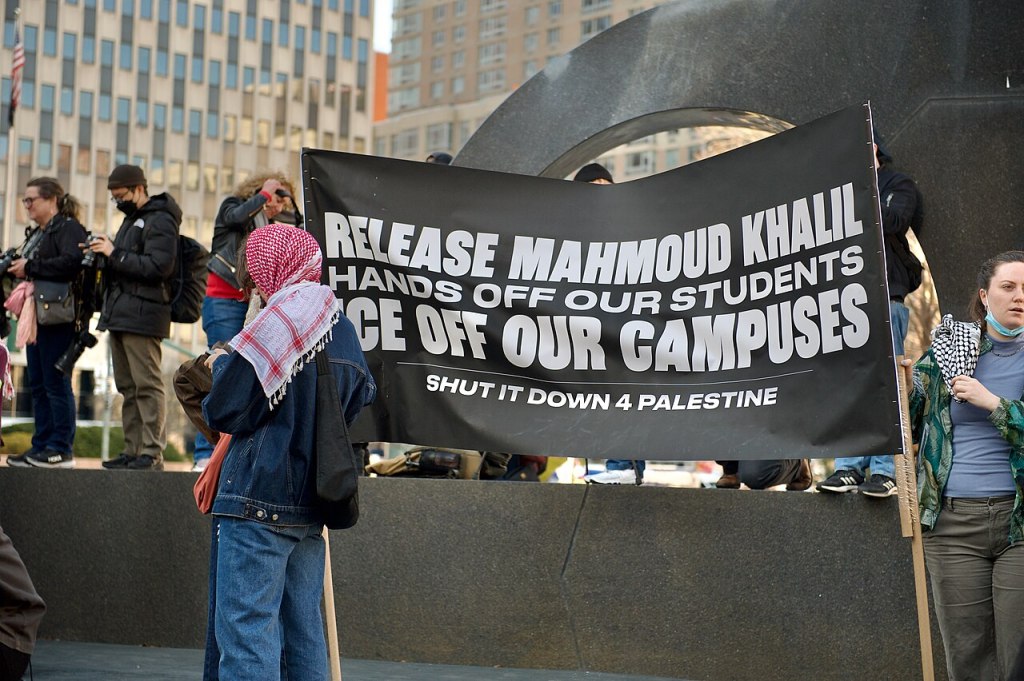
The Trump administration’s campaign to deport Mahmoud Khalil has entered a new and grave phase. On April 9, 2026, the Board of Immigration Appeals, the highest administrative appellate body in the immigration court system, denied Khalil’s appeal seeking dismissal of the deportation proceedings and issued what his lawyers described as a final administrative removal order. The ruling does not automatically end the broader litigation around his detention and deportability, but it brings the government materially closer to removing him from the United States. Khalil’s legal team has said the order will be challenged in the federal courts, and that he still cannot lawfully be detained or deported while his separate federal habeas case remains active.
Khalil, a lawful permanent resident of the United States and a recent Columbia University graduate, became one of the most prominent faces of the federal crackdown on non-citizens associated with pro-Palestinian campus protest activity. The case is not significant only because of the man at its center, but because it has become a test of whether immigration law can be used as an instrument to punish political speech that the executive branch disfavors. That is the core argument advanced by Khalil’s attorneys and by civil-liberties groups that have rallied to his defense; it is also the broader fear expressed by UN human rights experts and by a number of Democratic senators who said the administration was abusing immigration law in retaliation for protected expression.
The proceedings began in early March 2025. According to the U.S. Court of Appeals for the Third Circuit, Secretary of State Marco Rubio advised Homeland Security Secretary Kristi Noem that Khalil was removable under 8 U.S.C. § 1227(a)(4)(C), a rarely used foreign-policy provision that allows deportation when the secretary determines that a non-citizen’s presence or activities could have “potentially serious adverse foreign policy consequences” for the United States. Acting on that determination, federal agents arrested Khalil at his New York apartment on March 8, 2025, served him with a Notice to Appear, and then transferred him first to New Jersey and then to an immigration detention center in Jena, Louisiana.
That rapid transfer became one of the first controversies in the case. The Third Circuit record states that when Khalil’s lawyer filed a habeas petition in Manhattan in the early hours after the arrest, ICE’s detainee locator still showed him in New York, though he had already been moved to New Jersey and was soon transported onward to Louisiana. The transfer fight mattered because venue and jurisdiction would shape almost every later battle over whether federal courts could hear Khalil’s constitutional claims before the immigration process ran its course.
Within days, the government broadened the case against him. The amended Notice to Appear added a second ground of removability, alleging that Khalil had obtained lawful permanent resident status by fraud or willful misrepresentation of a material fact. According to the Third Circuit opinion, the government alleged that he failed to disclose work with UNRWA, continued employment tied to the British Embassy’s Syria Office in Beirut, and membership in Columbia University Apartheid Divest. Khalil’s lawyers have argued that this second charge was added only after his arrest and habeas filing, and that it was pretextual and retaliatory.
From that point, the case split into two tracks. In immigration court in Louisiana, the government pursued removal. In federal court, Khalil challenged both his detention and the legality of the government’s conduct. The immigration judge first found him removable on the foreign-policy charge after concluding that Rubio’s determination was itself “presumptive and sufficient evidence” of deportability and that the government was not required to produce additional proof. On June 20, 2025, the same judge issued a written opinion holding that Khalil was removable not only on the foreign-policy theory but also on the alleged fraud theory, denied his asylum, withholding, and Convention Against Torture claims, and ordered him removed to Algeria, of which he is a citizen, or Syria, where he was born.
The federal proceedings cut in a different direction, at least for a time. After the case was transferred from the Southern District of New York to the District of New Jersey, Judge Michael Farbiarz barred Khalil’s removal unless the court ordered otherwise, later concluded that the district court had jurisdiction, and then found that Khalil was likely to succeed on the merits of his challenge to the foreign-policy charge. As summarized by the Third Circuit, the district court held that Khalil had shown a likelihood of success against the Rubio determination, though not at that stage on the fraud charge, and on June 11, 2025 enjoined the government from detaining or removing him on the foreign-policy ground. He was released from detention on June 20 after 104 days in custody. Reuters reported at the time that rights groups saw the release as a major victory against what they described as unlawful retaliation for pro-Palestinian activism.
Yet that federal relief proved fragile. On January 15, 2026, a divided Third Circuit panel ruled that the district court had no jurisdiction to order Khalil’s release and to enjoin his detention in the way it had done, holding that the structure of the Immigration and Nationality Act largely channels such disputes through the immigration process before judicial review in the courts of appeals. Even so, the opinion also preserved the constitutional tension at the heart of the case. In the dissenting portion excerpted in the same opinion, the court recounted that Khalil’s petition alleged retaliation for protected speech, punitive detention, and a policy of targeting non-citizens for pro-Palestinian expression; it further noted that the government did not dispute the lower court’s finding that Khalil’s speech had been chilled while detained. Reuters described the Third Circuit ruling as a major victory for the administration because it reopened the possibility of Khalil’s re-detention.
The legal geometry of the case is therefore unusually complex. The administration has insisted that this is an immigration matter governed by Congress’s broad delegation of power over admission, removal, and foreign-affairs-related judgments. Khalil’s side, by contrast, has framed it as a constitutional emergency in which immigration machinery is being used to punish viewpoints. The Third Circuit’s own account of the case shows that Khalil’s claims include First Amendment retaliation, Fifth Amendment due process violations, unlawful punitive detention, unconstitutional vagueness in the foreign-policy provision as applied, and a challenge to the later-added fraud charge as retaliatory.
That is what gives the case its political and legal significance. Khalil is not an undocumented migrant picked up in a routine enforcement action. He is a lawful permanent resident. Longstanding Supreme Court precedent, cited in the Third Circuit materials themselves, recognizes that resident non-citizens within the United States have First Amendment protections. The question raised by this case is whether those protections become practically hollow if the executive can invoke immigration and foreign policy powers to detain and attempt to deport a permanent resident because of public advocacy, while shielding the key predicate decision from meaningful factual scrutiny in immigration court.
The foreign-policy charge is especially consequential because of how much it appears to depend on executive assertion rather than conventional evidentiary testing. The Third Circuit record shows that the immigration judge treated Rubio’s determination as sufficient in itself and did not allow discovery into the basis for the foreign-policy allegation. In plain terms, the government’s theory enabled the executive branch to say that Khalil’s presence had adverse foreign-policy consequences, and for that assertion to carry extraordinary weight in the removal process. Civil-liberties organizations have argued that such a framework is dangerously susceptible to ideological abuse.
The second, fraud-based charge has its own significance. Even if the foreign-policy theory ultimately weakens under constitutional scrutiny, the administration has tried to preserve deportation through a more conventional immigration allegation: supposed omissions or misrepresentations in Khalil’s green-card process. Reuters reported in September 2025 that an immigration judge ordered him deported on the basis of those alleged omissions. Khalil’s supporters have argued that this second track functions as a post hoc fallback, allowing the government to continue pressing for removal even after serious constitutional questions were raised about the first charge.
The human-rights dimension of the case is equally stark. Khalil was detained for 104 days and, according to AP, missed the birth of his first child while in immigration custody. He was born in Syria to a Palestinian family and holds Algerian citizenship; AP reported that he has said he fears persecution or even death if deported. UN special rapporteurs and independent experts called for his immediate release in March 2025, saying that solidarity with Palestinian civilians and advocacy for divestment are forms of political expression protected by international law, not terrorism.
Politically, the case has become a symbol of a broader transformation in the use of immigration power. Reuters reported in March 2025 that eight Democratic senators accused the administration of abusing immigration law in Khalil’s case and questioned whether the State Department had complied with the statutory requirement to notify Congress when invoking this kind of foreign-policy rationale. The case has therefore moved beyond a single deportation file. It has become a referendum on whether executive power in immigration can be used to create a class of politically vulnerable residents whose speech rights exist formally, but can be neutralized in practice through detention, transfer, and removal proceedings.
The latest Board of Immigration Appeals decision sharpens that danger. AP reported that the board’s rulings are not public, which itself limits public scrutiny of the reasoning used to reject Khalil’s appeal. What is publicly known is that the board denied his effort to dismiss the case and allowed the administration’s pursuit of deportation to continue. Khalil’s lawyers say the next step will be a petition for review in the Fifth Circuit, the federal appellate court that hears direct challenges to final removal orders from the Louisiana immigration courts. They also continue to litigate in the Third Circuit over the separate detention and constitutional issues.
For now, the case stands at a severe and revealing intersection: immigration law, foreign-policy prerogative, campus protest, and the shrinking margin between administrative power and political reprisal. Mahmoud Khalil’s case is not only about whether one man will be expelled. It is about whether the state may use the exceptional tools of immigration enforcement against a lawful resident whose central alleged offense is that his speech collided with the ideological priorities of those in power. If that boundary collapses, the significance will extend far beyond Khalil, and far beyond Columbia. It will mark a new threshold in the American treatment of dissent itself.

 THE PUNDIT
Leave a comment