
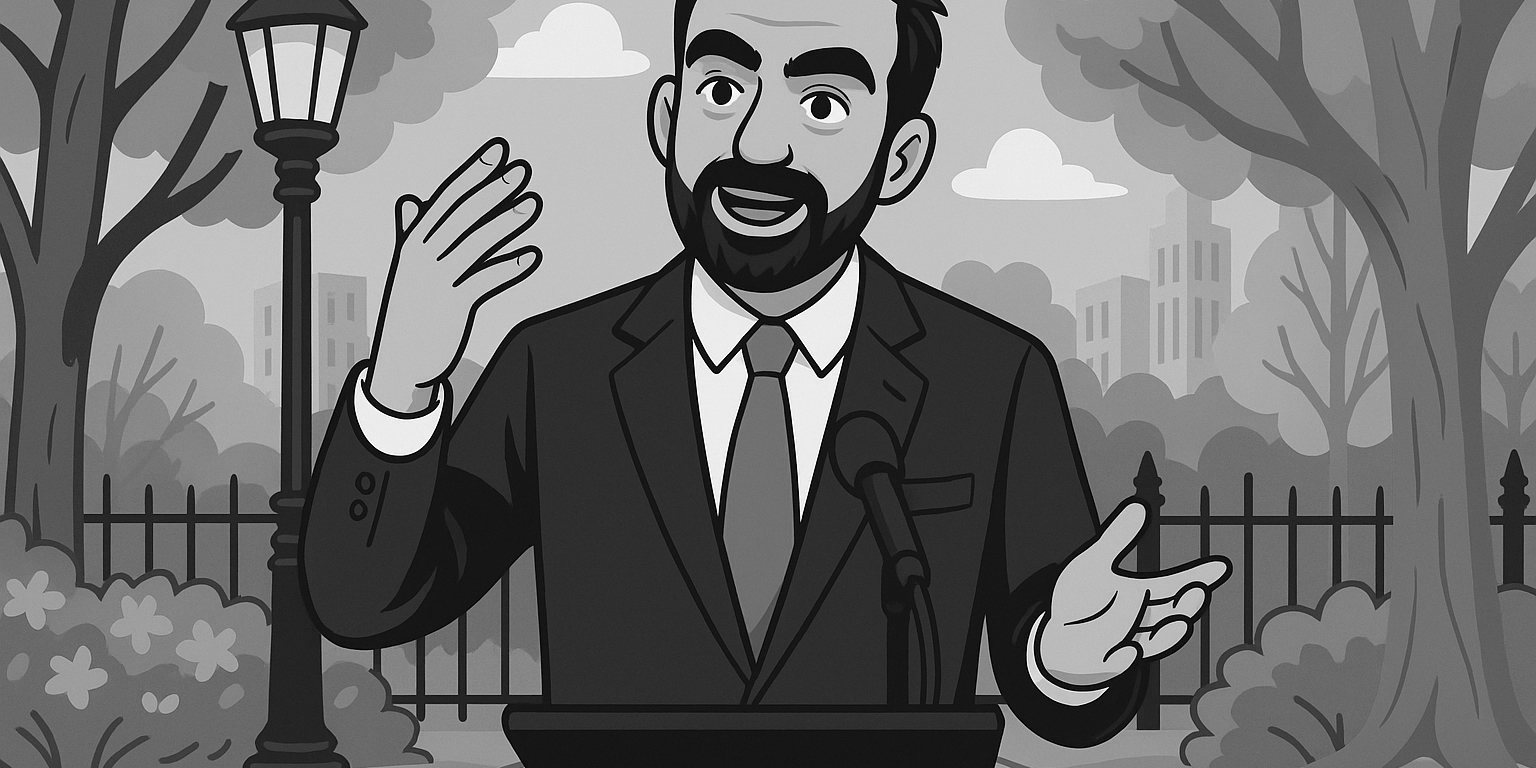
Tomorrow are the New York mayoral elections, and Zohran Mamdani still maintains the lead amid an extraordinary panic within the American Right. What’s important to note here is that the political center remains divided and suspicious. The center has always been composed of people whose minds dominate their hearts: half of them are essentially right-wing but don’t want to admit it—and they represent a significant force, if not the majority, within the traditional leadership of the Democratic Party. The other half lean left, but they understand that their leftism couldn’t be fully deployed.
What I want to emphasize is that Zohran Mamdani is not an isolated phenomenon, nor a product of social media or Gen Z, as many analyses since the Arab Spring have claimed—analyses that, in my view, obscured more than they explained about the roots of things. I certainly recognize that technology makes a real difference, but generational and “youth role” explanations are analytically shallow.
Zohran belongs to the American democratic socialist tradition—a tradition that is far from weak. The first socialist party in the United States was founded in 1876, and it played an active role in the struggles of what became known as the Progressive Era, between 1890 and 1915. That experience itself pushed American liberalism, especially during the interwar period, as exemplified by great figures like John Dewey, toward embracing social liberalism—that is, the belief in the need for fair distribution of wealth without adopting state ownership of the means of production, which was seen as a threat to democracy.
What truly weakened the democratic socialist or social democratic movement, as a distinguished political force on the electoral spectrum in America, was President Franklin Roosevelt’s New Deal after the Great Depression of 1929–1932. The New Deal reforms created a strong left-leaning wing within the Democratic Party, making the existence of a separate socialist party less justifiable.
During that period, a crucial figure emerged in the American socialist movement—Michael Harrington—who, in 1962, published The Other America, highlighting the poverty in the United States even though the New Deal reforms. Yet, the prompted democratic response by President John F. Kennedy’s anti-poverty legislation and Democratic President Lyndon Johnson War on Poverty program reddressed the very gaps Harrington had described. The only major issue that continued to divide the Democratic and Socialist parties was opposition to the Vietnam War. This pushed Harrington to break with the Socialist Party in 1973 and establish the Democratic Socialist Organizing Committee, which later evolved into the Democratic Socialists of America (DSA) in 1982.
Harrington nonetheless always held a core conviction: that there could be no realistic left in America outside the Democratic Party. He therefore remained loyal to it, despite his marginal role amid the rise of the New Democrats under Bill Clinton.
The decisive moment we are now witnessing began with Bernie Sanders’s campaign during the 2015 Democratic primaries. The movement found fertile ground to mobilize Democrats with leftist leanings inspired by Sanders’s socialist ideas, seeing them as a natural continuation—or correction—of what Barack Obama started but didn’t complete. Suddenly, this once-marginal organization became a powerful faction within the Democratic Party, with around 80,000 members and a congressional caucus that includes prominent figures like Alexandria Ocasio-Cortez and Rashida Tlaib.
The next turning point for the DSA came in 2023—before October 7—when the movement held elections for its political committee. A new generation of leftist, anti-Zionist figures rose to replace the more reformative old guard. Zohran’s rise and the historic campaign he has led in New York could mark a major shift that pushes the entire Democratic Party further left—precisely what terrifies the right, both the official right of the Republican Party and the concealed right within the Democratic Party itself.
However, there are serious risks. Chief among them, in my view, is that Zohran might win but fail to deliver a model of governance that is not only just but also competent. So far, his program and the DSA’s imagination remain confined to tax-and-spend policies—raise taxes, increase government spending—a framework that is not sustainable and was the very critique Republicans successfully used decades ago to dismantle the New Deal and the Democratic left, and even to beat the New Democrats in mid-1990s in the so-called Gingrich Revolution.
The alternative is not to rush toward unrealistic or authoritarian socialist policies like full control over production. Paradoxically, the more viable alternative may lie in adopting Steve Bannon’s rhetoric—which, in my view, is genuinely leftist in substance, though Bannon and the right are not sincere about it. That rhetoric calls for breaking down corporate capitalism to make space for cooperatives, medium-sized businesses, and innovative forms of ownership, including governmental and unions’ stakes. This is along with expanding protections for workers—not as minorities, women, or other identity groups, but simply as workers. This does not mean ignoring gender, racial, or environmental issues—it only means structuring discourse and priorities pragmatically and strategically in a moment of deep polarization, to create the conditions for addressing those very issues more effectively.
 Mahmoud Hadhoud