
From a country that reopened cinemas only in 2018, Saudi Arabia has moved in just a few years to become one of the Arab world’s most aggressive film markets—building screens at speed, underwriting production, funding festivals, and trying to transform itself from an exhibition territory into a full-spectrum cinema hub. The scale of the shift is no longer anecdotal. By the end of 2024, the Saudi box office had sold 17.5 million tickets, generated 845.6 million riyals in revenue, and expanded to 64 theaters and 630 screens across 10 regions, according to the Saudi Film Commission.
That commercial base is what makes the current Saudi moment different from earlier bursts of cultural excitement. This is not simply a wave of interesting filmmakers. It is a state-backed industrial project. The Saudi Film Commission says its cash rebate program offers non-refundable grants of up to 40% for local, regional and international productions, while its broader support system includes licensing, supplier access, workforce training, and location services designed to make the kingdom more competitive as a production base.
The strategy is visibly two-pronged. First, Saudi Arabia is building an audience. Second, it is building an ecosystem. On the audience side, the domestic theatrical market has grown at a pace unmatched in much of the region. On the ecosystem side, Riyadh and Jeddah now anchor a network of incentives, festivals, labs and funding channels intended to create filmmakers, not just moviegoers. The Saudi Film Commission’s inaugural industry yearbook describes the country as a “high potential production hub,” pointing to public and private investment, new soundstages, and a widening roster of productions.
The rise of local films is still modest compared with the dominance of Hollywood and large imported Arab titles, but it is no longer marginal. In 2024, Saudi films accounted for 18 releases, 1.4 million tickets sold and 56.8 million riyals in box-office revenue. That is still a small share of the total market, but it marks a meaningful shift: local cinema is moving from symbolic presence to measurable performance.
Just as important, some Saudi titles are beginning to generate a domestic popular culture footprint. The Film Commission’s 2024 industry publication notes that Sattar became the highest-grossing Saudi film at the local box office, earning more than 40 million riyals, while local films such as HWJN, Hajjan, Mandoob and To My Son have helped create the sense that Saudi cinema now has recognizable titles, genres and stars of its own.
What gives this moment its political and cultural significance, however, is not only the money. It is the appearance of a generation beginning to tell stories about Saudi society from within. The Cannes Film Festival’s selection of Norah in 2024 was a watershed: the Saudi Film Commission’s yearbook called it the first Saudi film selected for Cannes, and Cannes described it as the debut feature of Saudi filmmaker Tawfik Alzaidi, set in conservative Saudi Arabia of the 1990s. The Red Sea ecosystem and the Daw’ program were central to this emergence; the Daw’ initiative explicitly aims to finance professional filmmakers and enrich local short and feature production through grants.

That matters because Saudi cinema’s new wave is not just about infrastructure but about subjectivity: who gets to narrate Saudi life, in what language, and with what degree of aesthetic daring. Films like Norah signaled that Saudi stories can travel internationally without merely functioning as glossy national branding. They can be intimate, historically textured, and artistically serious. That internationalization is reinforced by institutions like the Red Sea International Film Festival, which says it exists to promote film culture in the kingdom, develop filmmakers, and support a robust film industry. By late 2023, according to the Saudi Film Commission’s yearbook, Red Sea had drawn 40,000 visitors, screened more than 130 films, and included 34 Saudi films or co-productions—up 40% from 2022.
The Red Sea Film Foundation’s funding arm has become one of the key engines of this broader regional and Saudi-centered momentum. The foundation says it has supported more than 280 films since 2021 and funds documentary, fiction, animation, shorts, features and episodic work, including Saudi shorts in production. This means Saudi cinema’s rise is happening not only through multiplex economics but also through curated development pipelines that connect local filmmakers to regional and international circuits.
There is also a gender dimension to this transformation. Reporting from the 2025 Red Sea festival noted that Arab female directors are helping reshape cinema in the region and that the Saudi festival has become an increasingly visible platform for more diverse narratives. That does not mean structural barriers have disappeared, but it does suggest that the new Saudi cinema is, at least in part, widening who appears on screen and who gets to stand behind the camera.
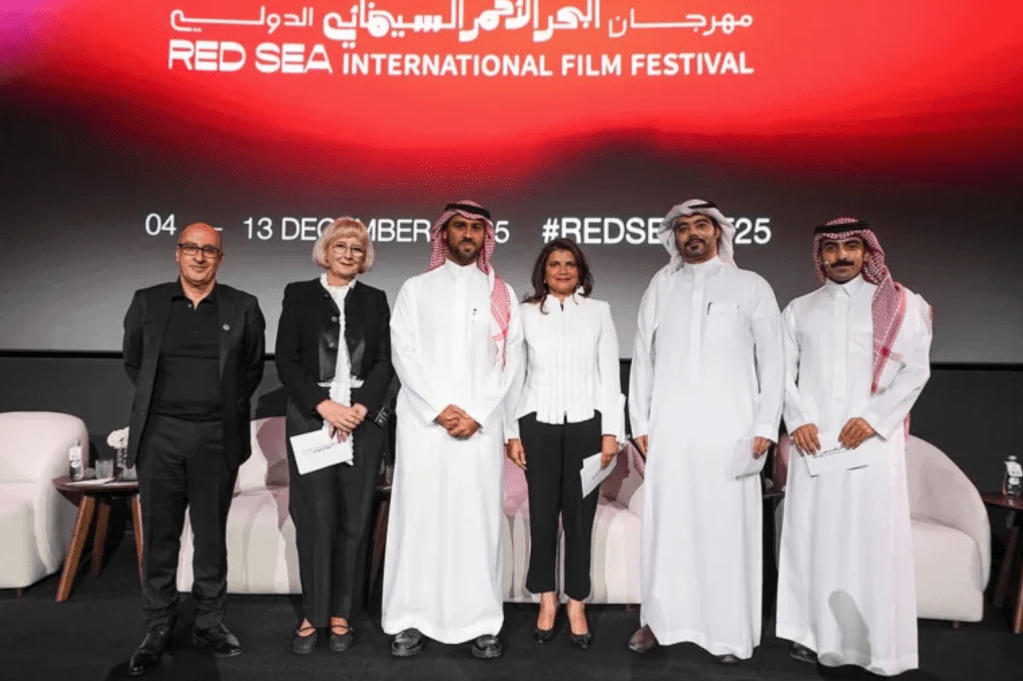
Still, it would be misleading to describe the Saudi film boom as a straightforward liberalization story. The same system that finances cinema also disciplines its horizon. Academic and journalistic reporting continues to point to censorship, self-censorship and the negotiated limits of representation as central features of the Saudi media environment. Even AP’s coverage of the Red Sea festival, while noting the expanding role of women filmmakers and the kingdom’s investment in film, also reported criticism from rights groups that these cultural initiatives can serve to redirect attention from restrictions on free expression and the broader human rights record.
That contradiction is at the heart of Saudi cinema’s emerging wave. The kingdom wants a creative economy, international prestige and domestic cultural vitality. But it also wants narrative management. The result is an industry that is opening rapidly while remaining politically bounded. Filmmakers are gaining resources that did not exist a decade ago, yet they continue to work within an environment where what can be shown, said and implied is never entirely artist-led.
Even so, the momentum is real. Saudi Film Confex, launched in 2023, drew 60,000 visitors according to the Film Commission’s yearbook, while the Saudi Film Festival drew more than 32,000 visitors in 2024. The Gulf Cinema Festival in Riyadh screened 29 films and combined screenings with training programs and industry seminars. These are the signs of a cinema culture trying to institutionalize itself, not just stage spectacles.
The commercial data also suggest that Saudi Arabia is no longer simply an emerging market but the central theatrical market in the Arab world. Industry reporting in March 2026 described Saudi Arabia as the leading box-office market in the MENA region, while the Saudi Arabia Media Market Outlook said that in the first half of 2025 alone, box office revenue reached 448 million riyals on 9.1 million tickets sold, across 635 screens.
So what is emerging in Saudi cinema? Not yet a fully autonomous national cinema in the classic auteurist sense, and not merely a state showcase either. It is something more hybrid and more consequential: a heavily financed, rapidly institutionalized film sphere in which commerce, cultural policy, prestige diplomacy and genuine artistic experimentation are all unfolding at once. Some of its films will function as soft power. Some will test boundaries. Some will simply entertain a new mass audience. Together, they are producing the first real Saudi cinematic public of the modern era.
 THE PUNDIT
Leave a comment