
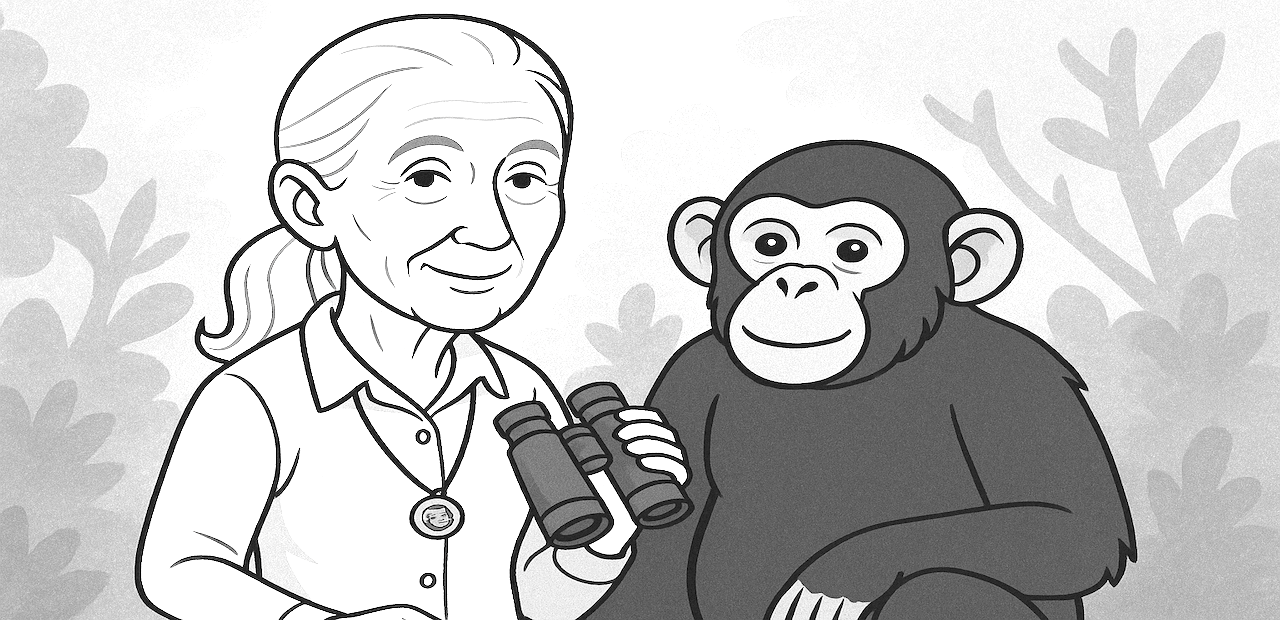
Yesterday, Jane Goodall passed away. The eminent anthropologist was one out of eight persons who were accepted by Cambridge University to enroll directly for the PhD without a bachelor’s degree. The university decision was enabled by the fact that Goodall was one of the three anthropologists chosen by the paleoanthropologist Louis Leaky to study the behavior of apes in their natural environments in Africa.
The most notable among Goodall’s works was her study of Kasakela chimpanzee community in Gombe Park in Tanzania. Out of her study, Goodall culminated in two conclusions that disrupted classic scientific convictions. First, Goodall has found that apes are not vegetarians after she watched a chimpanzee hunting termites out of a mound. The more revolutionary discovery, however, was that chimpanzees were able to develop tools after observing them stripping off twigs to make them more effective as tools. Leaky concluded that the long years scientific belief that man was the toolmaker has to succumb to some ad hoc — either the man is moreover, or the chimpanzee are early homos.
Nevertheless, Goodall’s study of chimpanzee extreme violence in power conflicts was more astounding. Dominant chimpanzee females were ready to kill other young females to maintain their status in the troop. Even more, the chimpanzee community in Gombe Park engaged in four years civil war of attack and retreat preserving, conceding and acquiring territories.
The anthropological hypotheses about the deep violent instinct in the man emerged earlier, but gained momentum by Goodall’s observations, among other anthropological efforts. Raymond Dart considered violent conflict as a main promotor of the man’s evolution. The great leap forward came with the work of Robert Ardery, the founding father of political anthropology. Ardery crystallized Dart’s idea in what he called the hunting hypothesis arguing that man from his early history was required to be a violent hunter in order to flourish and survive. Politically, Ardery developed the concept of the territorial imperative, pointing out that appropriating lands and building primitive nations happened with the apes in early forms of social contracting.
Such anthropological insights proped the belief in that the explanation of homo sapiens exclusive survival was the extremination of other homo species. Modern Islamic scholars even interpreted the Qur’anic parable, when the Angels questioned the God’s order to nominate Adam as his agent on the earth. “Will you put on the earth who corrupts and sheds blood?” (Qur’an 2:30), thus the angels expressed their experience of the homo behavior through what were perhaps early homo civil wars.
Ardery’s anthropological enterprise in the 1970s was parallel to Michel Foucault philosophical study of scoiety formation through relations of power. For Foucault, the society, being a grid of relations of power, is modelled as a permanent civil war, in which each structural element pursue power in an endless conflict. The will to power, revalorized by Foucault, can take other forms beyond the political and economic ones, involving the cultural and knowledge fields, where the will to know, to truth-making, or to claim owning the truth, acts as a shade of power.
Both enterprises, the anthropolgical and the philosophical, have reoriented our attention ot the deep violent disposition in the human psychology, based on the hunting hypothesis. The man, used to be a hunter, is deeply haunted by violence and competition as survival strategies.
Both enterprises, nonetheless, reflected that the man salvation is conditioned by resisting this violence disposition. We need to tame our hunting instinct and to sublimate our primtive psychology. As Foucault put it, we need to move over from the art of governing to the art of living through the asthetetics of life’s beuty and the techne of self education.
Yeterday, I was reading Bernard Harcourt’s reflection on his critical praxis as a litigator and critical theorist. We should “spread the burden of violence with care and equity,” thus he recommended. It is our only way to face what he calls “the fragility of life.”
For Goodall, salvation originates in hope, which differs from wishful thinking. Hope is an instinctive trait of men that helped them to survive and evolve, for hope is linked to doing.
 Mahmoud Hadhoud