
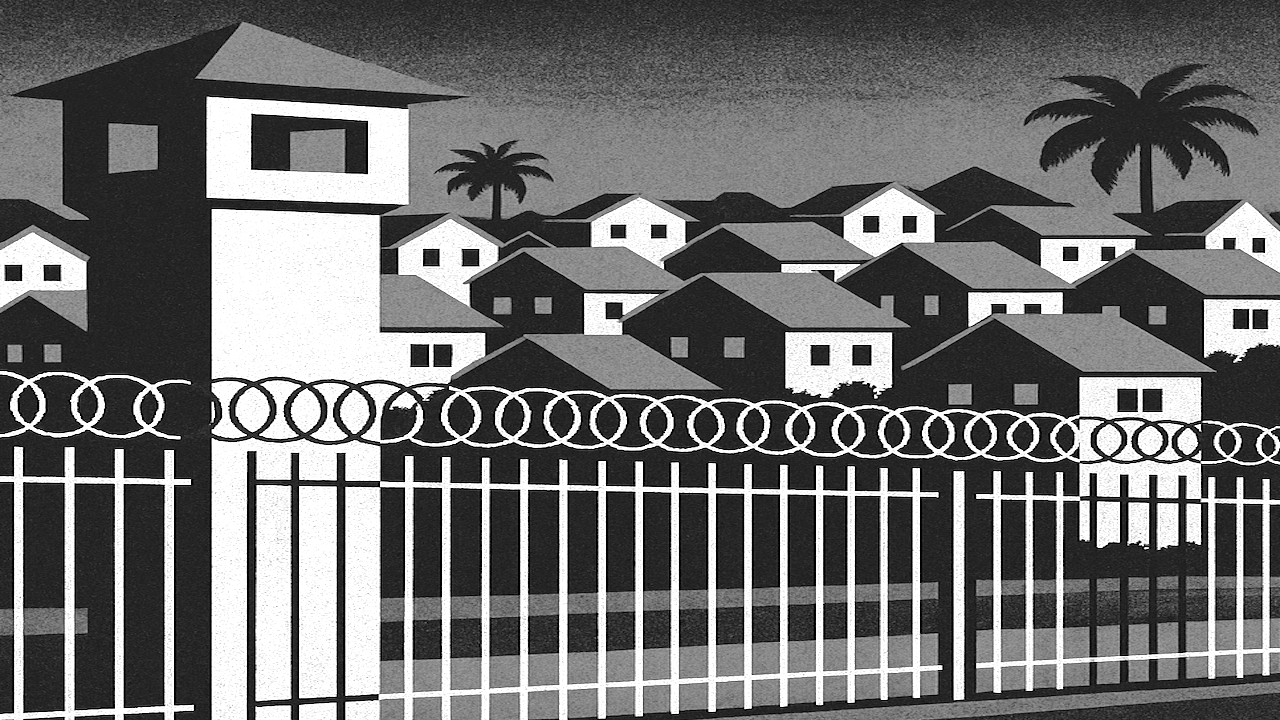
The questions of who controls the mechanisms of wealth redistribution and how this control generates social inequalities have always been key debates both in theoretical and political terms. The phenomenon of gated communities (residential compounds isolated by walls from the regular neighborhoods) in some countries of the Global South, such as in Brazil, Mexico, Pakistan and Egypt, is one instance of such debates.
Even in the United States, the rise of gated communities is a tangible reflection of shifting social and residential dynamics. Research indicates that by the late 1990s, around 16 million people were living in gated communities in the U.S. — up from roughly 4 million in 1995. One study found that homes in these communities command a price premium of about USD 30,000 compared to similar non-gated homes. Developers and real-estate analysts report there are more than 25,000 gated communities nationwide, with particularly dense growth in the sun-belt states of California, Florida and Texas.
One common argument is that what’s happening in these countries should not be described as neoliberalism, on the grounds that the state plays a central role in managing and distributing resources. This, in turn, leads to what some liberal debaters see as a failure in much of the leftist analysis of many phenomena in Global South: it misidentifies the state itself rather than the class structure as the primary site of critique.
Engaging theoretically with this claim, here are three theoretical points that may help enrich an important debate.
(1)
First, neoliberalism has not historically operated in the absence of the state; in fact, it has rarely functioned without a repressive authority capable of imposing neoliberal policies or reforms. In Chile — the earliest famous neoliberal experiment — the model was built on a military coup and a repressive military regime led by General Augusto Pinochet. Out of national or authoritarian considerations, the general even refused to privatize copper, despite fully committing to the monetarist policies of the neoliberal economists known as Chicago Boys. One of the intellectual architects of neoliberalism, Friedrich Hayek — author of The Road to Serfdom and The Constitution of Liberty — defended Pinochet’s repression and considered it necessary for achieving freedom in the long run.
The same dynamic appeared in Argentina in 1978, where a Ford factory was even used to detain and torture workers. The case of Thatcher’s Britain was no exception: Thatcher militarized British politics through two major campaigns — the 1982 Falklands military campaign and crushing the coal miners’ strike in 1984.
Regardless of one’s position on neoliberalism, while its theoretical definition calls for the withdrawal of the state from the market, neoliberalism has never meant anarchism or libertarianism in the sense of dismantling or shrinking the state. This is a matter of historical record — though, of course, neoliberal theorists are entitled to claim that these experiments do not reflect their pure theory, just as socialists often argue that no actual socialist experiment represents true socialism.
(2)
Second, the theoretical divide over state and class is as follows: Karl Marx did not deny the existence of the state but saw it as the arm of the ruling class to implement its policies. This Marxist analysis faces two problems. First, it underestimates the fact that the state has functions and manifestations that exceed its class function (Marx himself did engage with the state in more complex ways later in his political analyses such as The Eighteenth of Brumaire and The Civil War in France). Second, in his critique of political economy, he did not devote sufficient space to analyzing the state’s role in the market — an omission, in my view, that left him without the insight to anticipate the state’s crucial role in saving capitalism from its crises in 1929–1932 and again in 2008 with several occasions in-between.
Conversely, in many parts of the Global South, people have a kind of pathological relationship with the state: they want it to stop being authoritarian, but at the same time want it to play a developmental and nationalist role that lifts them forward and achieves international status. So many intellectuals lean toward a Hegelian–Weberian vision of the state. Most of the prominent figures in Arab–Islamic intellectual heritage critique that flourished in the Arab-speaking countries after the 1967 defeat of Arabs by Israel, were politically either explicit or implicit Hegelians — such as Abdallah Laroui and Aziz al-Azmeh.
The problem with the Hegelian–Weberian approach is the opposite of Marx’s: it views the state as completely detached from class — as an independent, rational entity, perhaps authoritarian but autonomous. This simply is not better than class reductionism. The state, in sociological terms, has been key to the class interests, and further to the maintenance of class structure itself. That’s what happened in Egypt under Nasser’s regime, which the old aristocracy genuinely despised and still mocks, and it’s also what happened with FDR in the United States, whom big business still resents. My view is that the state is certainly not merely the arm of the ruling class, but it is by no means detached from it or its interests.
(3)
Third, take Egypt as an example. You can certainly argue that the problem lies in the military establishment, or in the devastation wrought by Nasserism on civil society and the Egyptian bourgeoisie in the 1950s and 1960s, or perhaps in what culturalists call Arab-Islamic sultanism or the legacy of authoritarianism. But you cannot deny one concrete fact (I’m saying fact here, not opinion):
The astonishing acceleration of wealth accumulation among a small segment of big business since the current regime came to power in 2014 in the aftermath of a military coup. For example, Naguib Sawiris, Egypt’s wealthiest businessman and leading real estate, construction and telecommunications investor, doubled his wealth according to Forbes up to $5 billion. Real estate tycoon Hisham Talaat Mostafa has accessed overnight into the billionaires’ club as the market value of his shareholding rose from roughly $250 million to $1.3 billion. This was accompanied by the equally astonishing impoverishment of the lower classes (from 25% in 2013 up to 35% poverty rate in 2023 according to official figures).
Whether or not you choose to call this neoliberalism is a matter of terminology, but you cannot say the problem lies in leftist analysis while denying the existence of a dangerous class phenomenon in Egypt.
We are facing a socio-economic formation in which the state manages mechanisms that clearly lead to inequality and massive wealth accumulation among the top one percent. The class element in this relationship can’t be dropped out.
The phenomenon of gated communities is a direct product of this moment. In Cairo’s traditionally affluent neighborhoods like Maadi, Heliopolis, and Mohandessin, there were no gates or fences in the past. Nor were there walls around the high class summer resorts such Agami, Hanoville, Miami, or even the elite resorts of Sharm el-Sheikh, Hurghada, and Marsa Alam. But now, gated compounds dominate places like the North Coast and El Gouna in terms of resorts, and Sheikh Zaid City and New Cairo.
We are not merely facing a class gap but “class segregation,” which we can euphemistically call class apartheid or the class version of the historical (still present in hidden forms) racial segregation. This is not simply about some being richer and others poorer; it’s about a spatial division between the rich and the poor. Is this neoliberalism? Fine — perhaps not by textbook definition. But it is undeniably, first, a class phenomenon and not merely a political statist one, and second, a new phenomenon in Egypt, not a historically inherited one.
A parallel case is India. Is India capitalist like Germany? Certainly not; the difference in social and economic structures is enormous. But does anyone deny that India today is capitalist and simultaneously governed by a fascist government? No. Is the problem merely that India has rich and poor, like Germany or France or the UK? Also no. There is an acute spatial and cultural segregation between classes in India.
 Mahmoud Hadhoud